Case 1
Pressure ulcer
An 85-year-old female patient had a 22×15×5 cm Grade IV sacral pressure ulcer that had not closed for 3 years. In the 5th month of Neoderm® treatment the wound had closed completely.
Fully closed in 5 months

Advanced Skin Renewal Solution
Products
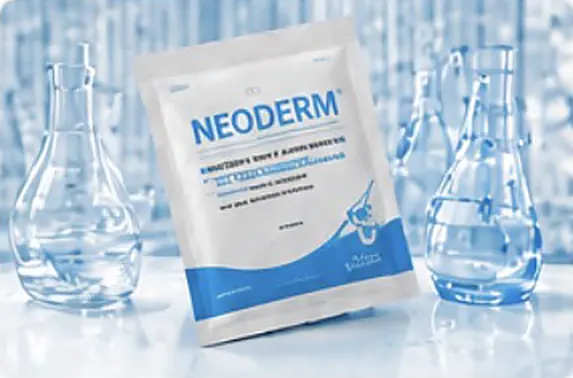
Developed as a new alternative for treating acute and chronic wounds, Neoderm® is a natural, biocompatible, biodegradable, bioactive wound dressing that provides fast healing in wound and burn treatment.
Definition: Neoderm® is a natural, biocompatible, biodegradable, bioactive wound dressing that provides fast healing in wound and burn treatment. Developed by Turkish scientists and produced through university-industry cooperation as the first wound dressing made in Türkiye, its effective role in wound healing has been proven in clinical and animal studies.
Technical properties and mechanism of action: Neoderm® is a bioactive wound dressing containing EGF (epidermal growth factor) within a gelatin matrix, developed for use in wound and burn treatment.
Neoderm® is a natural, biocompatible, bio-soluble, porous matrix that contains EGF. While this sponge-like matrix serves as a scaffold for cells to attach to, the release of EGF activates cell proliferation, increasing epithelialisation and granulation tissue formation and speeding up the healing of acute and chronic wounds.
Thanks to its bio-soluble gelatin, hydrophilic nature and three-dimensional porous structure, it makes it easier for cells to attach at the wound site and helps the wound rebuild. Over time the gelatin matrix breaks down at the wound site and gives way to newly formed tissue.
EGF, a mitogenic polypeptide, is loaded into the gelatin structure and starts to act on wound healing from the end of the inflammation phase. It also activates granulation tissue formation and epithelialisation, accelerating healing.
Neoderm® is a white, homogeneous, natural matrix that is easy to apply to any wound site. It takes the shape of the wound, is absorbed by the body over time and gives way to new tissue.
The skin is a complex vital organ that needs attention not only in illness or injury but also in good health. Wound care aims to treat wounds that heal slowly or not at all, wherever they appear on the body. Beyond being a medical problem, hard-to-heal wounds can cause great psychological and social distress.
Hard-to-heal wounds have many causes. The most common are venous insufficiency, diabetes, reduced arterial blood flow, long-lasting bone infection (osteomyelitis), radiotherapy-related skin and soft tissue damage, calciphylaxis from kidney failure, vasculitis, fungal infections, burns, trauma and skin cancers. Around 10% of venous ulcer patients become unable to work. Diabetes affects about 5% of the population; because of reduced blood flow and sensation, foot ulcers appear in about 15% of cases, and about two thirds of these recur after healing.
Healing deep wounds with major skin and tissue loss (large burns, surgical wounds, traumatic tissue damage, diabetic ulcers, pressure sores and similar chronic cases) is a major challenge. Delayed healing can lead to loss of independence, reduced quality of life and productivity, loss of organs and even death, and it carries a heavy economic burden.
Conventional dressings only cover the wound surface, protecting it from external factors and keeping it moist; they play no functional role in tissue repair. Biomaterials, by contrast, are developed to take over the function of injured or lost tissue, temporarily or permanently. Neoderm® is a product of that approach.
The effective role of Neoderm® in wound healing has been proven in clinical and animal studies. There is no known contraindication to the product.
Neoderm® is not an antibacterial product and must never be used on infected wounds. Before using Neoderm®, laboratory tests should confirm whether the wound is infected.
Case 1
An 85-year-old female patient had a 22×15×5 cm Grade IV sacral pressure ulcer that had not closed for 3 years. In the 5th month of Neoderm® treatment the wound had closed completely.
Fully closed in 5 months
Case 2
A 24-year-old male patient, paraplegic for 6 years, had an 8×6 cm Grade III sacral pressure ulcer that had not closed for 3 months. On day 12 of Neoderm® treatment the wound area had closed completely.
Fully closed in 12 days
Case 3
A male patient treated for diabetes mellitus for 30 years had many wounds of different sizes on the dorsal and plantar surfaces of the toes of both feet. Neoderm® was started after debridement; by day 5 granulation tissue had clearly increased, and after 3 months the wound was fully epithelialised.
Fully epithelialised in 3 months
Case 4
A 41-year-old male patient had, for 20 years, a venous ulcer of about 10×15 cm at the lateral malleolus of the right foot, leaving bone exposed. By the end of month 4 the wound surface was covered with granulation tissue and epithelialisation had begun from the edges.
Granulated in 4 months
Case 5
A 45-year-old male patient had a wound in the right pretibial region that had not closed for 5 years. After 6 months of application the wound was observed to have closed completely.
Fully closed in 6 months
Contact us to learn more about our solutions that create value for health.